
Table of Contents
- The Double-Shoulder Fold Method That Keeps Prints Smooth
- Rolling vs. Folding: Which Prevents Wrinkles on Graphic Tees?
- Step-by-Step Folding Instructions for a Crease-Free Finish
- How to Store Graphic Tees to Protect Prints Long-Term
- How to Remove Creases from Graphic Tees Without Damaging the Print
- Space-Saving Folding for Travel and Drawer Organization
- Fabric-Specific Folding: Cotton, Blends, and Heavy-Weight Tees
- Frequently Asked Questions
Last Updated: September 14, 2026
The Double-Shoulder Fold Method That Keeps Prints Smooth
The double-shoulder fold is the fastest way to fold graphic tees without creasing the print. Fold each shoulder inward toward the center, then fold the shirt in half so the graphic sits on the outside, never pressed against itself.
That last detail is the whole trick. Most people fold a graphic tee like any other shirt, trapping the print inside a stack where every fold line lands on the design, and the ink eventually cracks along those lines.
Nation Swag Designs delivers high-quality, comfortable streetwear for patriots and veterans, offering a powerful way to express identity through faith-based, tactical, and sovereign lifestyle graphic designs. Our curated collection of unisex hoodies and crewneck t-shirts, crafted from trusted brands like Gildan and Bella + Canvas, ensures lasting comfort and reliable everyday durability, and the print surface matters most. The double-shoulder method protects it because the graphic never creases against itself.
Here is the sequence:
- Lay the shirt face-down on a flat surface, graphic touching the table.
- Fold the left shoulder and sleeve back toward the center seam.
- Repeat with the right shoulder, aligning the edges.
- Fold the shirt in half from the bottom hem up.
- Flip it over. The graphic faces out, uncrossed by any fold.
The technique works because fold lines land on the blank back panel instead of the printed front, keeping fabric tension even so the ink does not stretch or crack.
Rolling vs. Folding: Which Prevents Wrinkles on Graphic Tees?
Rolling wins for travel and tight storage; folding wins for drawer organization and quick access. Both prevent print creases if the graphic faces outward, but fabric and print method decide which is safer.
Neither method is universally better. Rolling eliminates hard fold lines, making it ideal for a shirt pulled from a duffel bag after a long drive. Folding creates structure for tidy drawer stacks, but a fold line that lands on the print becomes a permanent crack point over time.
| Method | Best For | Crease Risk on Print | Space Used |
|---|---|---|---|
| Double-shoulder fold | Drawers, shelves, quick access | Low if graphic faces out | Medium |
| Roll method | Travel, packing efficiency | Very low | Low |
| KonMari vertical fold | Wardrobe management | Low | Low |
| Hanging | Long-term storage | None | High |
Here is where fabric and print type tip the decision:
- Screen-printed graphics on 100% cotton: Folding is fine as long as the graphic faces out. Cotton holds a fold, so a crease set into the print can become a crack line. If you fold, keep the fold off the design.
- Screen-printed graphics on poly blends: Rolling is safer. The synthetic fibers have more memory and spring back, but they also hold static and can cling to the print surface, so a tight roll with the graphic inward is riskier than a loose roll with the graphic outward.
- Vinyl and heat-transfer prints: Roll these, always. Vinyl is a plastic film bonded to the fabric, and a hard fold line can lift the edge of the transfer. Rolling distributes the bend across the whole curve instead of concentrating it on one line.
- Heavy-weight knits: These create deeper fold lines because there is more fabric to bend. Roll them for travel and file-fold them for storage, but never fold a heavy-weight tee so the crease crosses the print.
Short on space? Use a hybrid: fold the shirt in half with the graphic out, then roll the bundle. You get a roll's compact shape with a fold's structure, and the print never sits against itself.
Step-by-Step Folding Instructions for a Crease-Free Finish
A crease-free result comes down to surface, tension, and fold order. Skip one and fold lines appear on the print within days.
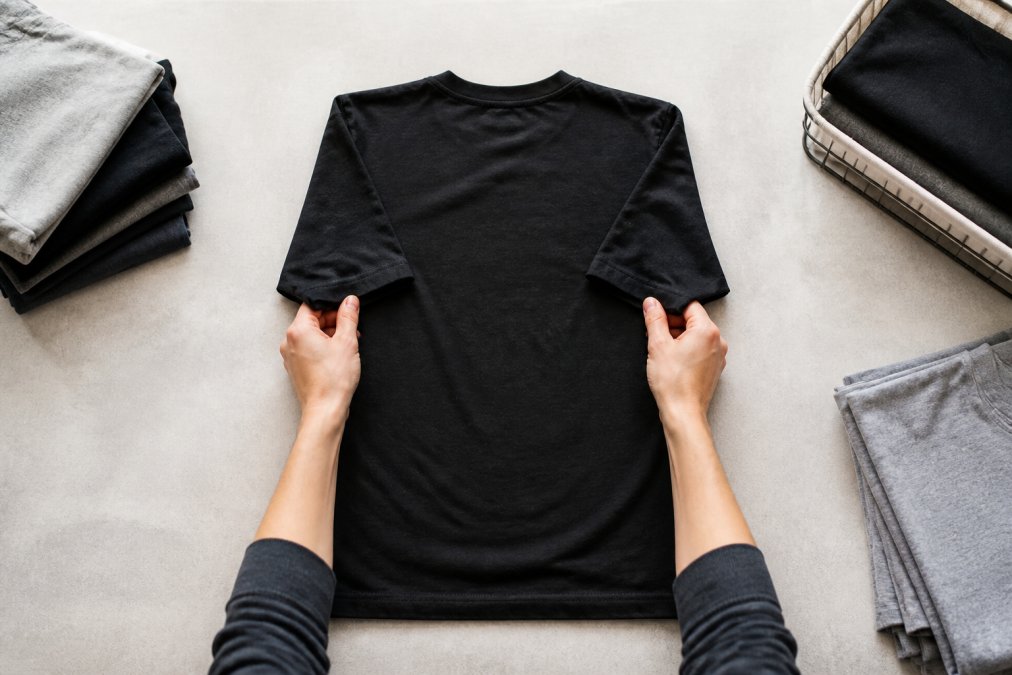
Preparing the Shirt on a Flat Surface
Start with a clean, smooth, flat surface. A bed works; carpet does not, because its uneven surface pushes wrinkles into the fabric as you fold.
Button or zip any closures, then smooth the fabric from shoulders to hem. Work out wrinkles before you fold, folding over one locks it in place.
Turn the shirt face-down so the graphic rests against the table. This protects the print from the surface and keeps it on the outside of the finished bundle.
Executing the Fold Without Stressing the Fabric
Fold with light, even pressure. Pulling fabric tight stretches the knit and stresses the print edges, where cracking usually starts.
- Fold the left shoulder inward, keeping the sleeve parallel to the body.
- Fold the right shoulder to match, aligning the collar edges.
- Fold the bottom hem up to just below the collar.
- Flip the bundle so the graphic faces up.
You should see a neat rectangle with the full design visible and no fold line crossing it. If a fold line cuts through the print, unfold and shift the fold point to the blank fabric above or below the design.
How to Store Graphic Tees to Protect Prints Long-Term
Vertical storage beats horizontal stacking for print protection. In a horizontal stack, every shirt transfers weight downward onto whatever lies flat below, usually the graphic, and over weeks that load presses fold lines into the ink. File-folding shirts upright eliminates the load entirely.
Here is how drawer depth and orientation actually affect crease formation:
- Shallow drawers (under 4 inches deep): File-fold shirts so the folded edge faces up and the graphic faces the side wall. Shirts should stand with a slight lean, not packed so tight they bow. If a shirt has to be forced in, the drawer is overfilled and the compression will mark the print.
- Deep drawers (6 inches or more): You can stack two rows front-to-back, but keep the back row shorter so the front row does not lean into it. Never stack a second layer on top of an upright row, that reintroduces the weight problem you just solved.
- Shelves: Use the same file-fold orientation, but place a nonslip liner underneath so shirts do not slide and collapse into each other. Collapsed shirts crease at the fold point within a few days.
- Hanging: Only for short-term use. A heavy-weight tee on a hanger pulls at the shoulders and stretches the neckline over months. If you must hang, use a wide contoured hanger and fold the shirt over the bar rather than hanging it by the collar.
For long-term and seasonal storage, the rules change slightly because time magnifies every pressure point:
- Store in a cool, dry place away from direct sunlight, which fades screen-printed ink over months.
- Avoid sealed plastic bins that trap moisture and can promote mildew in the fabric; if you use plastic, choose bins with ventilation or leave the lid loose.
- Use breathable cotton storage bags for seasonal items, and fold shirts loosely rather than tightly so fibers are not under constant tension.
- Never hang a heavy-weight tee by the collar for months at a time.
- Rotate stacks every few months if you keep any horizontal storage at all, shifting the fold line prevents a permanent crease from setting in one spot.
According to guidance from the American Cleaning Institute on fabric care, proper storage and handling extend the life of garments more than most people expect. The same logic applies to printed apparel: less friction, less pressure, longer print life.
How to Remove Creases from Graphic Tees Without Damaging the Print
The safest fix for a creased graphic tee is steam, not direct heat. Heat cracks screen-printed ink, so relax the fibers without pressing an iron onto the design.
Try these methods in order:
- Hang the shirt in a steamy bathroom for 15 to 20 minutes
- Use a handheld steamer, holding it a few inches from the fabric
- Iron the shirt inside out, never directly on the graphic
- If you must iron the front, place a cotton cloth between the iron and the print
For a deeper look at how heat and washing affect printed apparel, the FTC's consumer guidance on textile care labels explains what care instructions legally mean and why following them protects your purchase.
Space-Saving Folding for Travel and Drawer Organization
Travel packing rewards rolling; drawer organization rewards the vertical fold. Use both, depending on where the shirt is going.
For a suitcase, roll each shirt tightly from the hem up and pack rolls side by side, they compress well, resist creasing, and fit more into a carry-on. For a drawer, file-fold and stand shirts upright.
A few practical habits that make both methods work:
- Group shirts by fabric weight so heavy-weight tees do not crush lighter ones
- Keep prints facing the same direction in a stack
- Leave a little slack in the roll so the fabric is not stretched
- Pack graphic tees last, on top, when space allows
Compression aids packing efficiency, but too much pressure over long trips can still mark a print. When checking a bag, layer soft clothing between the shirts and the suitcase wall.
Fabric-Specific Folding: Cotton, Blends, and Heavy-Weight Tees
Different fabrics need different handling, a 100% cotton tee behaves nothing like a poly blend, and heavy-weight knits need more care than light ones.
Cotton: Pure cotton holds a fold but wrinkles easily if left compressed. Fold with slightly loose tension and store vertically. Preshrunk jersey knit, like the Gildan 5000 crewnecks we carry, keeps its shape through repeated folding.
Cotton blends: A little polyester helps blends resist wrinkles better than pure cotton, so you can fold them tighter without worrying about crease lines, the synthetic fiber adds memory and springs back.
Heavy-weight tees: Thicker knits create deeper fold lines. Fold with the graphic facing out and stack no more than four or five high, the stack's own weight causes creases over time.
Tri-blends and light fabrics: These drape more than they hold a fold. Roll them instead of folding, and store them on top of heavier items.
The Textile Exchange's materials guidance notes that fiber content drives how a garment wears over time, which is exactly why a folding routine should match the fabric, not just the design.
Here is a quick reference for what we recommend:
| Fabric | Fold Method | Storage | Max Stack Height |
|---|---|---|---|
| 100% cotton | Double-shoulder fold | Vertical | 5 shirts |
| Cotton blend | Double-shoulder fold | Vertical or flat | 6 shirts |
| Heavy-weight knit | Double-shoulder fold, graphic out | Vertical | 4 shirts |
| Tri-blend | Roll method | Flat, on top | 3 shirts |
If you want shirts built to survive this kind of handling, our Smoking nationSwag Heavyweight Unisex Crewneck T-shirt uses preshrunk jersey knit with double-needle hems and a taped neck, so the fabric holds its shape and the print surface stays flat through repeated folding and washing.
Creases on graphic tees are a storage problem, not a laundry problem. Keep the print facing out, match your method to the fabric, and store shirts so nothing presses on the design.
Nation Swag Designs builds heavy-weight crewnecks and hoodies for people who wear their values on their chest and expect the print to last. Our unisex sizing, Gildan and Bella + Canvas construction, and faith-based, tactical, and patriotic designs are made for everyday wear that holds up. Get started with Nation Swag Designs and fold your next shirt knowing the graphic will still look sharp a year from now.
Frequently Asked Questions
How do I fold a graphic tee so the print doesn't crack?
Always fold with the graphic facing inward or place a sheet of acid-free tissue paper over the print before folding. This creates a barrier that prevents the ink from rubbing against itself or other fabrics. Avoid folding directly along the printed area; instead, fold just outside the design edges. Storing shirts flat or hanging them also reduces stress on the print over time.
What is the best way to store graphic tees to prevent fading?
Store graphic tees in a cool, dry place away from direct sunlight. UV rays break down screen-printed inks and cause fading. Fold shirts with the graphic facing inward and stack them loosely in drawers or on shelves. Avoid hanging graphic tees on wire hangers for long periods, as the shoulders can stretch and the print can distort. For long-term storage, use breathable cotton bags rather than plastic bins.
Can I use an iron on a graphic tee to remove creases?
Yes, but never place the iron directly on the print. Turn the shirt inside out and iron the back of the graphic on a low setting, or place a cotton pillowcase over the design and iron the front. High heat will melt or crack the screen-printed ink. A steamer is a safer option for removing creases from graphic tees because it uses moist heat without direct contact.
Does folding graphic tees damage the print over time?
Folding itself does not damage the print if done correctly. The risk comes from sharp creases pressed directly into the ink, which can cause cracking after repeated stress. Using the double-shoulder fold method, keeping the graphic on the inside, and avoiding tight compression in storage all protect the print. Rotate folded stacks occasionally so the same fold lines do not stay pressed into the fabric for months.