
Table of Contents
- Step 1: Build Your Foundation with Tactical Apparel for Everyday Wear
- Step 2: Master How to Style Graphic Hoodies for Fall 2026
- Step 3: Add Mid-Layers for Weather-Adaptive Warmth
- Step 4: Choose Outerwear That Complements Patriotic Streetwear
- Step 5: Create Patriotic Streetwear Outfit Ideas with Red, White, and Blue
- Step 6: Adapt Your Layers for Body Type and Weather Shifts
- Common Layering Mistakes to Avoid
- Frequently Asked Questions
Last Updated: September 11, 2026
Step 1: Build Your Foundation with Tactical Apparel for Everyday Wear
Layering patriotic streetwear for fall 2026 starts with the base layer. It's the first garment against your skin, and it controls moisture, temperature, and how the rest of your outfit sits. At Nation Swag Designs, we build every recommendation around that principle.
Fall weather swings hard. A 60-degree afternoon becomes a 40-degree evening fast, so your foundation has to work in both (weather.gov).
Best Base Layers for Fall Weather
The best base layers for fall are midweight cotton tees and lightweight crewnecks that breathe by day and insulate after dark. Skip "thermal" unless you run cold; you'll overheat indoors.
A graphic tee works as a base layer when the print sits flat and the cotton is substantial. The Operation Epic Fury T-Shirt is a solid example: a vintage eagle military patch graphic on classic cotton that holds its shape under a hoodie.
Why Fabric Weight Matters for Layering
Fabric weight, measured in grams per square meter (GSM), determines whether a layer adds warmth or just bulk. A 150 GSM tee is summer weight; a 180-200 GSM tee holds up as a fall base (textileschool.com).
Heavyweight cotton also resists the pilling and stretching that thin fabric develops after a few washes. That matters when a tee sits under two other layers for months.
Step 2: Master How to Style Graphic Hoodies for Fall 2026
Learning how to style graphic hoodies for fall 2026 comes down to one rule: let the graphic lead, then build quiet layers around it. A bold print needs neutral support, not competition.
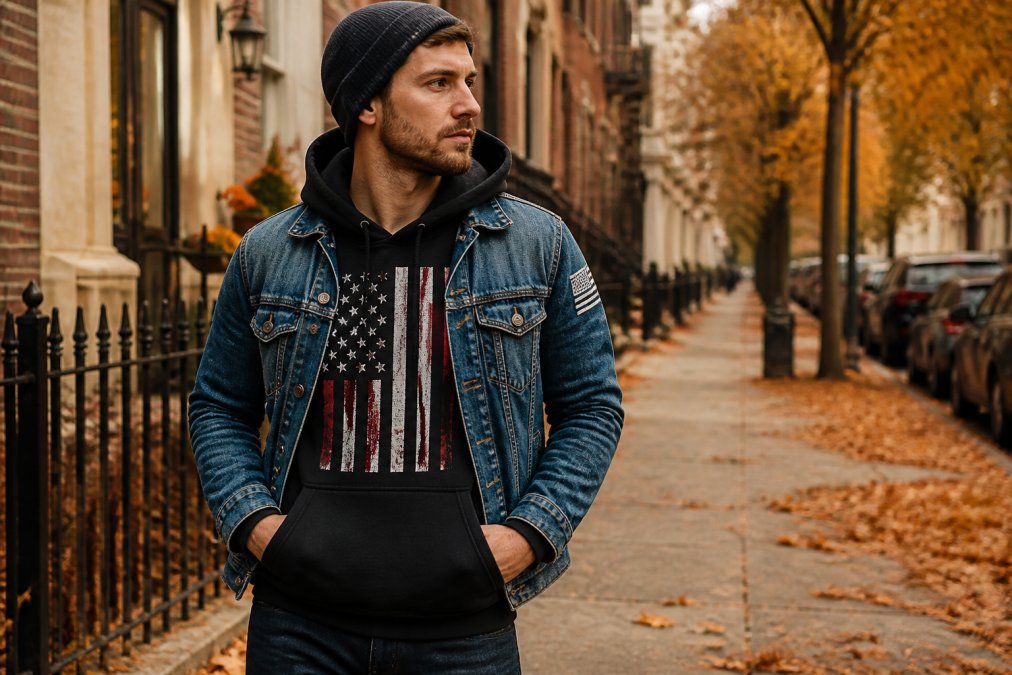
Pairing Heavyweight Hoodies with Outerwear
Heavyweight hoodies pair best with outerwear that has room in the shoulders and chest. A jacket that fits snug over a tee will bind and ride up over a hoodie.
A heavy blend hoodie in the 8-9 oz range hits the sweet spot (gildan.com). Thicker than that and you can't move your arms; thinner and the hoodie collapses under a coat. The Veteran Shield Strength Hoodie uses that weight range with a lightning bolt design that reads clearly from across a room.
Avoiding Graphic Print Clashes
Graphic print clashes happen when two loud designs compete for the same visual space. The fix: one graphic per outfit, maximum two if one is small.
- Keep logos on your hoodie, solid colors on your pants
- If your tee has a print, your hoodie should be plain
- Match print scale: a large back graphic pairs with a small chest logo, never another large print
Step 3: Add Mid-Layers for Weather-Adaptive Warmth
Mid-layers are the adjustable part of the system, separating a fall outfit that works all day from one that only works at 8 a.m. Sitting between base and outerwear, the goal is a piece that adds warmth without flattening the graphic underneath or trapping sweat against your skin.
Fabric Mechanics: What Actually Keeps You Warm
Warmth comes from trapped air, not fabric thickness alone. Lofted fabrics, fleece, brushed flannel, quilted nylon, trap air against your body, while tightly woven cotton traps almost none, which is why a heavy tee alone stops working below about 50°F.
Moisture management matters just as much. Cotton holds water and loses insulation when damp; polyester and wool blends move sweat away so the mid-layer keeps its loft. For days that start cold and end warm, a breathable mid-layer (fleece, flannel) beats one that seals (down, heavy wool) because you can shed it before you overheat.
A practical rule: if you'll be indoors more than an hour, choose a mid-layer you can remove without exposing a soaked base, breathable fabrics and a wicking base layer.
Mid-Layer Options That Work With Patriotic Graphics
Not every mid-layer plays well with a bold hoodie or tee. The best add texture and warmth while keeping the graphic readable.
- Flannel overshirts. Brushed cotton flannel in a muted plaid (olive, charcoal, tan) adds visual texture without competing with a red, white, and blue print. Wear it open so the graphic shows through the front.
- Quilted vests. A quilted vest adds core warmth and leaves your arms free, which keeps the hoodie sleeves and cuffs visible. Look for a vest with a matte shell so it does not shine under streetlights.
- Lightweight fleece. A 100-200 weight fleece (measured in grams per square meter) is the most versatile mid-layer for 45-55°F. It packs down, sheds cleanly, and comes in solid neutrals that frame patriotic graphics.
- Chunky knit cardigans. A cable-knit or ribbed cardigan adds mass and texture for leaner frames. Wear it unbuttoned over a graphic tee so the print stays the focal point.
Avoid mid-layers with their own large prints or logos, two competing graphics split the eye and read as cluttered rather than styled.
The Three-Layer System by Temperature
Here's how the system breaks down by temperature range, with the mid-layer as the adjustable piece:
| Temperature Range | Base Layer | Mid-Layer | Outer Layer |
|---|---|---|---|
| 55-65°F | Cotton tee (180 GSM) | None needed | Light overshirt |
| 45-55°F | Cotton tee (180 GSM) | Flannel or 100-200 GSM fleece | Denim jacket |
| 35-45°F | Heavyweight tee (200+ GSM) | Quilted vest | Insulated jacket |
| Below 35°F | Thermal or wool-blend base | Chunky knit or fleece | Parka or heavy coat |
The key move is making your mid-layer the piece you shed first. A vest or open flannel comes off without messing up your sleeves or hood, leaving your base layer and graphic intact.
Why This Matters for Patriotic Streetwear
Most fall layering guides treat mid-layers as generic warmth. For patriotic streetwear, the mid-layer is also a styling tool: it controls how much of your red, white, and blue graphic reads at a glance. Worn open, a neutral mid-layer frames the graphic; worn closed, it hides it. Decide which effect you want before you leave the house.
Step 4: Choose Outerwear That Complements Patriotic Streetwear
Outerwear should frame your patriotic streetwear, not bury it: open fronts, structured shoulders, and enough room to show the layer underneath.
Overshirts and blazers work better than heavy parkas for most fall days. An overshirt worn open shows your hoodie graphic while adding structure, and a blazer over a plain heavyweight hoodie reads intentional rather than sloppy.
What most guides miss: outerwear color does more work than outerwear style. A neutral outer layer in olive, charcoal, or tan makes red, white, and blue graphics pop; a patterned coat fights them.
Step 5: Create Patriotic Streetwear Outfit Ideas with Red, White, and Blue
Patriotic streetwear outfit ideas work best when red, white, and blue appears in one or two pieces, not all three at full saturation. Restraint makes the palette look styled instead of costume-like.
Color Blocking with Patriotic Palettes
Color blocking with patriotic palettes means placing solid blocks of red, white, and blue next to each other with clean edges. A navy hoodie over a white tee with red laces or a red beanie gives you all three colors without a single print.
Keep the blocks large and the transitions sharp. Small scattered red accents read as noise.
Balancing Bold Graphics with Neutral Staples
Bold graphics need neutral staples to breathe. Wide-leg denim, structured trousers, and plain canvas sneakers give your graphic piece room to be the focal point.
This is where a capsule approach pays off. A small set of neutral bottoms and one or two statement hoodies covers a full week of outfits.
- Wide-leg denim in dark wash or black
- Structured trousers in olive or charcoal
- Plain white or black canvas sneakers
- One neutral overshirt
Step 6: Adapt Your Layers for Body Type and Weather Shifts
Body-type specific layering changes what "fits well" means, and most fall fashion advice ignores it. Weather-adaptive layering is the other half: the same outfit has to work from a 45°F morning to a 65°F afternoon without a full change. This section covers both, because they interact.
Body-Type Layering Techniques
Layering is about proportion, not size: add warmth without adding width where you don't want it, and add visual mass where you do.
Broader frames and athletic builds. Keep mid-layers thin and outerwear structured. A quilted vest adds core warmth without adding width at the waist. Choose outerwear with a defined shoulder seam and a straight hem; boxy cuts add bulk. For base layers, a 180-200 GSM tee sits close without clinging.
Leaner frames. Chunky knits, heavyweight hoodies (8-9 oz), and textured mid-layers add visual mass that balances wide-leg bottoms. A cable-knit cardigan worn open over a graphic tee adds depth without hiding the print.
Shorter torsos. Long outerwear can swallow the frame. Choose hip-length overshirts and jackets, and keep the mid-layer short so it does not peek below the hem. A cropped or waist-length vest is a strong option.
Longer torsos. A longer outer layer (mid-thigh) balances the proportions. Layer a longer tee under a shorter hoodie to create a visible hem line that breaks up the vertical.
Curvier frames. Avoid stiff, boxy outerwear that stands away from the body. Look for softer shells with a bit of stretch, and use an open front to create a vertical line that lengthens the silhouette. A belt over an open overshirt can define the waist without adding bulk.
A common pattern across all body types: size the outer layer up one, keep the mid-layer close to the body, and let the base layer do the moisture work. That gives you room to move without a boxy silhouette.
Weather-Adaptive Layering: Fabric Weights and Shed Points
Fall weather swings hard, and the daily high is a trap. Check the hourly forecast and plan your shed points, the moments you remove a layer, before you leave.
Fabric weight is your main tool. Base layers in the 180-200 GSM range work for most fall days; mid-layers in the 100-200 GSM fleece range or brushed flannel add warmth without bulk; outer layers should fit over the full system, not over a tee.
Moisture-wicking matters when you'll be active. A polyester or wool-blend base moves sweat away so your mid-layer keeps its loft; a cotton base is fine for low-activity days but holds moisture and loses insulation when damp.
Plan for a 20-degree swing with three shed points:
- Morning (coldest). Full system: base, mid-layer, outer layer.
- Midday (warmest). Remove the mid-layer first. An open flannel or vest comes off cleanly without disturbing your base or hood.
- Afternoon (cooling). Add the mid-layer back. If you carried a packable vest or fleece, this takes seconds.
Putting It Together
Body type and weather are not separate problems. A broader frame needs thinner mid-layers, which also shed faster as the temperature rises; a leaner frame can carry a chunkier knit, which holds more warmth for a cold morning. Match mid-layer thickness to both your frame and the day's temperature swing, and the outfit works from the first cold hour to the last warm one.
Common Layering Mistakes to Avoid
The most common layering mistakes all trace back to buying layers that fit in isolation rather than as a system. Each piece works alone; together they bind, bunch, or overheat.
- Sizing every layer to your body. Size outer layers up one so the system has room.
- Wearing two loud graphics. One focal print per outfit, always.
- Skipping the base layer weight check. A thin tee undermines every layer above it.
- Ignoring fabric texture. Mixing smooth cotton with chunky knit creates textural contrast; mixing two smooth fabrics looks flat.
- Buying for the daily high only. Plan for the low, then shed.
Fall layering rewards planning over impulse buying. Nation Swag Designs makes that easier with heavyweight unisex hoodies and tees built from trusted blanks like Gildan and Bella + Canvas, so your base and mid-layers hold their shape all season. Our faith-based, tactical, and sovereign lifestyle graphics give you statement pieces that carry the outfit, while versatile unisex sizing means the fit works on real bodies. Get started with Nation Swag Designs and build a fall rotation that expresses your values without sacrificing comfort.
Frequently Asked Questions
What are the essential streetwear layering pieces for fall 2026?
Start with a moisture-wicking base layer, add a graphic hoodie or heavy blend crewneck, then top with an overshirt or blazer. Finish with wide-leg denim or structured trousers. For patriotic streetwear, include red, white, and blue accents via accessories or a statement piece like the Veteran Shield Strength Hoodie. This combination handles temperature swings and keeps your look intentional.
How do you incorporate patriotic themes into modern streetwear?
Use subtle nods like a small flag patch on a tactical jacket, a red, white, and blue color palette on a hoodie, or a graphic tee with a vintage eagle. Balance bold graphics with neutral staples so the patriotic element stands out without overwhelming. Layering a patriotic hoodie under a solid overshirt keeps the theme visible but polished for everyday wear.
How can I style unisex hoodies for a tactical streetwear look?
Choose a heavyweight unisex hoodie like the Shield Strength Hoodie, then layer it under a utility vest or bomber jacket. Add cargo pants and tactical boots to complete the look. For a cleaner vibe, pair with wide-leg denim and a structured overshirt. The key is to mix functional pieces with streetwear staples for a balanced tactical aesthetic.
What fabrics are best for layering patriotic apparel in autumn?
Cotton-polyester blends like those in Gildan hoodies offer warmth without bulk. For base layers, merino wool or synthetic blends wick moisture. Mid-layers should be fleece or heavy cotton. Outerwear can be nylon or canvas for wind resistance. Avoid pure cotton next to skin if you sweat, as it stays wet and chills you. Look for air-jet yarn fabrics that resist pilling.