
Table of Contents
- Heavy Weight Cotton vs Ring Spun: What's the Real Difference?
- Ring Spun Cotton vs Regular Cotton: Understanding the Yarn
- Combed Cotton vs Ring Spun: Quality and Processing
- Heavyweight Cotton Fabric Properties Explained
- Ring Spun Cotton Benefits: Why Softness and Longevity Matter
- Heavy Weight vs Ring Spun: Durability, Comfort, and Printing
- Price-to-Value Comparison for Bulk Buyers
- Environmental Impact: Heavy Weight and Ring Spun Production
Heavy Weight Cotton vs Ring Spun: The Complete Comparison
Last Updated: July 25, 2026
When choosing between heavy weight cotton and ring spun fabric for apparel, the decision affects durability, comfort, and longevity. At Nation Swag Designs, we've fielded countless questions from customers trying to understand which option delivers better value. This guide breaks down the real differences and helps you make an informed decision based on actual fabric properties.
Heavy weight refers to fabric density (measured in ounces per square yard), while ring spun describes how yarn was twisted during manufacturing. A shirt can be both heavy weight AND ring spun, or neither, or one but not the other. Understanding what each term means is the first step toward choosing apparel that matches your expectations.
Ring Spun Cotton vs Regular Cotton: Understanding the Yarn
Ring spun cotton is produced using a specific yarn-spinning technique that twists individual cotton fibers more tightly than conventional carded cotton. This creates higher tensile strength, meaning garments withstand repeated washing and wear better than carded cotton. The tighter twist also creates a smoother surface, making ring spun cotton garments noticeably softer to the touch, almost silky compared to regular carded cotton.
Ring spun cotton's tighter structure means dyes penetrate more evenly, resulting in richer colors that resist fading. For screen printing, ring spun cotton provides a superior surface for ink adhesion, so graphics stay sharp and don't crack after multiple washes.
Combed ring spun cotton goes further: fibers are combed before spinning to remove short fibers and impurities, producing an even finer, softer yarn. Brands like Bella + Canvas use Airlume combed and ring spun cotton (4.2 oz weight) for exceptional softness, while the Hanes Beefy-T uses 100% ring spun cotton at 6.1 oz for a heavier feel with similar durability benefits.
Combed Cotton vs Ring Spun: Quality and Processing
Combed cotton and ring spun cotton address different manufacturing stages. Combing happens before spinning: raw cotton fibers are passed through fine-tooth combs that remove short fibers, seed fragments, and impurities. Ring spinning is the method used to twist those fibers into yarn.
When you see "combed and ring spun" on a label, the cotton received both treatments. Combing improves the quality of starting material; ring spinning improves how that material is twisted into yarn. The combination produces the softest, most durable result. The Gildan Hammer H000 uses 6.0 oz combed ring spun cotton, delivering both softness and durability.
Heavyweight Cotton Fabric Properties Explained
Heavy weight cotton is defined by its density: typically 6.0 oz per square yard (oz/yd²) or higher. Lightweight cotton t-shirts run 4.2-4.5 oz/yd², while mid-weight options fall between 5.0-5.9 oz/yd². A 6.1 oz heavy weight cotton t-shirt has noticeably more fabric per square inch than a 4.2 oz lightweight option.
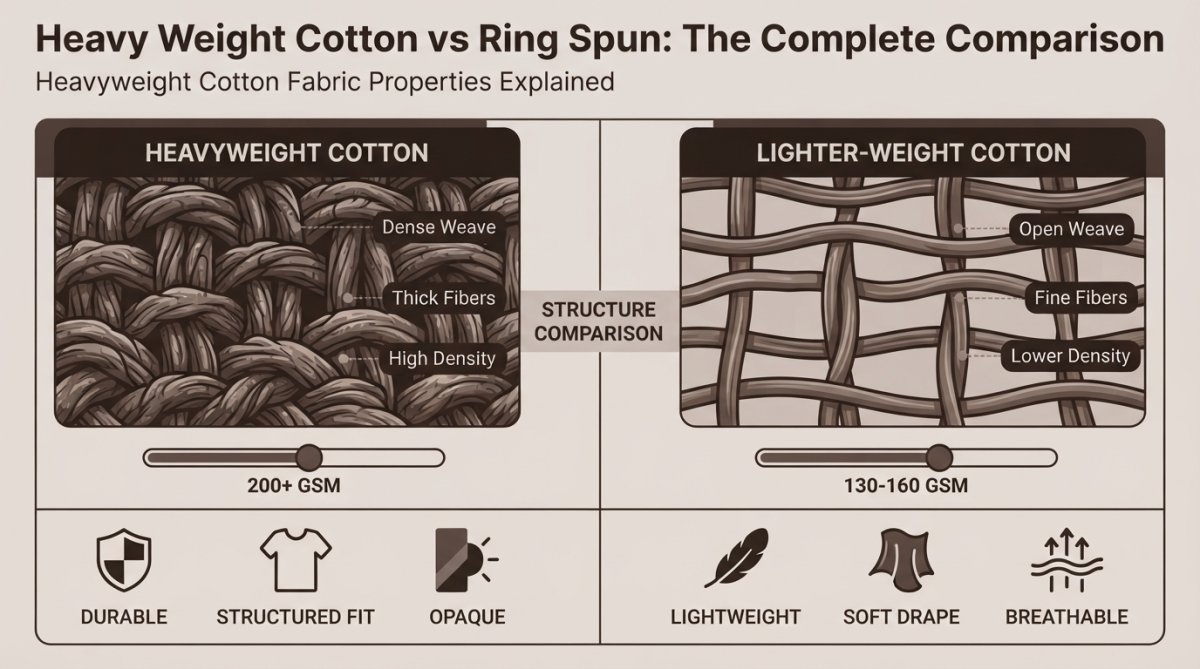
Heavy weight cotton's density creates a tighter weave with fewer gaps between fibers. This provides several benefits: it acts as a better barrier against stains, holds dyes more effectively for deeper colors, and provides superior ink adhesion for screen printing. The trade-off is breathability, a 6.1 oz shirt won't breathe as well as a 4.2 oz option, which matters in hot climates. Heavy weight cotton also shrinks more initially (typically 5-8%) because the denser weave traps more moisture.
Weight, Weave Density, and Durability Factors
The relationship between weight and durability is direct but not absolute. A heavier fabric generally lasts longer than a lighter fabric made from the same fiber. However, the spinning method (ring spun vs carded) and fiber quality (combed vs uncombed) matter equally or more than weight alone.
A 6.0 oz combed ring spun cotton shirt will outlast a 6.1 oz carded cotton shirt because ring spinning and combing improve the fiber structure, even though weights are nearly identical. Durability also depends on construction: double-needle stitching on seams, lay-flat collars, and shoulder-to-shoulder taping extend garment life. The Hanes Beefy-T includes double-needle stitching throughout, reinforcing stress points where seams typically fail first.
Ring Spun Cotton Benefits: Why Softness and Longevity Matter
Ring spun cotton delivers two primary benefits: exceptional softness and proven longevity. The softness comes from the tighter yarn twist, creating a smoother fiber surface with fewer protruding fibers that irritate skin. Ring spun garments don't pill as quickly and maintain smoothness through dozens of wash cycles.
The tighter structure means individual fibers are held together more securely. When stress is applied, stretching during wear, agitation during washing, friction against skin, the yarn resists breaking. Garments show less pilling and less overall degradation compared to carded cotton after the same number of washes. For bulk buyers and promotional apparel, ring spun cotton's durability translates to better perceived value.
Tensile Strength and Fiber Length Advantages
Tensile strength is the force required to break a material. Ring spun cotton has measurably higher tensile strength than carded cotton because the spinning process aligns fibers and twists them tightly, distributing stress evenly across the yarn. Fiber length also contributes to durability: longer cotton fibers (like Pima or Egyptian cotton, typically 1.5+ inches) produce stronger yarn than shorter fibers (like Upland cotton, typically 0.8-1.0 inches).
The practical outcome: ring spun cotton garments maintain shape, color, and structural integrity longer than carded cotton. Necklines don't stretch out as quickly, seams don't fray as easily, and the overall garment doesn't lose form after repeated wearing and washing.
Heavy Weight vs Ring Spun: Durability, Comfort, and Printing
When comparing heavy weight and ring spun cotton directly, you're comparing two different variables: weight (density) versus yarn construction method. The ideal scenario combines both: heavy weight ring spun cotton, which delivers the substantial feel and durability of heavy weight with the softness and longevity of ring spun.
The Hanes Beefy-T (6.1 oz, 100% ring spun) exemplifies this combination. It feels substantial, resists shrinking and fading better than lighter options, and the ring spun construction means it won't pill or degrade as quickly as a 6.1 oz carded cotton shirt would. If choosing between heavy weight carded cotton and mid-weight ring spun cotton, the decision depends on your priorities: heavy weight carded cotton provides the substantial feel but sacrifices the softness and durability advantages of ring spinning.
Screen Printing Surface and Ink Adhesion
One overlooked factor in apparel selection is how well the fabric accepts screen printing inks. Heavy weight cotton with a tight weave provides a superior printing surface compared to lightweight options, and ring spun cotton improves ink adhesion further.
Screen printing works by pushing ink through a fine mesh screen onto the fabric surface. Ring spun cotton's smoother, tighter surface provides better contact with ink while having enough texture for the ink to grip. Heavy weight cotton's denser weave means ink doesn't sink as deeply into the fabric, resulting in crisper graphics with better definition and more vibrant colors.
Breathability and Moisture Management
Breathability is how well air passes through fabric. Heavy weight cotton compromises breathability due to its density, while lighter-weight cotton breathes more effectively. A 4.2 oz lightweight cotton shirt allows air to circulate more freely, keeping you cooler in hot weather. A 6.1 oz heavy weight shirt traps more heat because the denser weave restricts airflow.
Ring spun cotton doesn't inherently improve breathability compared to carded cotton of the same weight. However, because ring spun cotton is often available in lighter weights, you can achieve both breathability and the softness benefits of ring spinning. The Next Level 3600 (4.3 oz, combed ring spun) offers these advantages.
Shrinkage, Fit, and Long-Term Wear
Cotton shrinks when exposed to heat and moisture, particularly during the first few washes. Heavy weight cotton typically shrinks 5-8% initially, while lighter-weight cotton shrinks 3-5%. Ring spun cotton doesn't shrink less than carded cotton of the same weight, the spinning method doesn't affect shrinkage rates. However, combed and pre-shrunk cotton minimizes this problem.
Understanding shrinkage is critical for fit. Many manufacturers pre-shrink heavy weight blanks during production to minimize this issue. Long-term wear depends on how well the fabric resists pilling and color fading. Ring spun cotton shows less pilling because the yarn structure is more stable, while heavy weight cotton resists fading better because the denser weave holds dyes more effectively.
Price-to-Value Comparison for Bulk Buyers
Pricing varies significantly based on weight, fiber quality, and spinning method. The Gildan Hammer H000 (6.0 oz, combed ring spun) starts around $3.17 per unit for bulk orders. The Hanes Beefy-T (6.1 oz, ring spun) runs approximately $4.06 per unit. The Bella + Canvas 3001 (4.2 oz, combed and ring spun) costs around $4.63 per unit.
Price differences reflect manufacturing processes and fiber quality. For bulk buyers, the question becomes: does the price difference justify the durability and comfort improvements? If more expensive shirts last 50% longer, the cost-per-wear might actually favor the higher-priced option.
| Fabric Type | Weight (oz/yd²) | Spinning Method | Starting Price | Best For |
|---|---|---|---|---|
| Gildan Hammer H000 | 6.0 | Combed Ring Spun | $3.17/unit | Bulk orders, durability-focused buyers |
| Hanes Beefy-T | 6.1 | Ring Spun | $4.06/unit | Workwear, promotional apparel, printing |
| Bella + Canvas 3001 | 4.2 | Combed & Ring Spun | $4.63/unit | Premium retail, maximum softness |
| Next Level 3600 | 4.3 | Combed Ring Spun | $4.17/unit | Screen printing, lightweight comfort |
Environmental Impact: Heavy Weight and Ring Spun Production
Cotton production carries environmental costs that vary based on farming practices, water usage, and manufacturing processes. Heavy weight cotton requires more raw cotton per garment, which means greater water consumption during cultivation. A single cotton t-shirt requires approximately 700 gallons of water from planting to harvest. Heavy weight garments require proportionally more water than lightweight options because they contain more cotton fiber.
Ring spun cotton production uses more energy than carded cotton production. However, the durability benefits mean the garment lasts longer, potentially offsetting the higher manufacturing impact through extended use-life. A ring spun shirt worn 100 times has a lower environmental cost-per-wear than a carded shirt worn 50 times. The most sustainable apparel choice is one you'll wear for years rather than seasons.
Choosing between heavy weight cotton and ring spun cotton depends on your priorities: durability, comfort, climate, and budget. Heavy weight cotton delivers a substantial feel and superior printing surface. Ring spun cotton offers exceptional softness and proven longevity. The best choice combines both, heavy weight ring spun cotton, which is exactly what Nation Swag Designs delivers through trusted manufacturers like Gildan and Bella + Canvas. These brands prioritize combed and ring spun construction in their heavy weight offerings, ensuring your patriotic or faith-based apparel looks sharp, feels comfortable, and lasts through years of wear. Explore Nation Swag Designs's collection to find the heavy weight ring spun options that match your values and lifestyle.
Frequently Asked Questions
Is ring spun cotton considered heavy weight cotton?
Ring spun cotton and heavy weight cotton are not the same thing, though they can overlap. Ring spun refers to how yarn is twisted, using a ring spinning process that creates tighter, more durable yarn with better tensile strength. Heavy weight cotton refers to fabric weight, typically 6.0 oz/yd² or higher. You can have lightweight ring spun cotton (like Bella+Canvas 3001 at 4.2 oz) or heavier carded cotton. The best premium apparel combines both: ring spun yarn construction in a substantial, durable weight.
What are the disadvantages of heavy weight cotton?
Heavy weight cotton offers durability but comes with trade-offs. The main disadvantages include reduced breathability and moisture management in warm climates, the tighter weave and heavier fabric can feel warmer and less breathable than lighter options. Heavy weight fabrics may also take longer to dry after washing and can feel stiffer initially, though this softens with wear. Additionally, heavier garments require more fabric, which typically increases production costs. For those seeking maximum softness from the start, lighter-weight ring spun options may feel more comfortable immediately.
Does ring spun cotton shrink more than regular cotton?
Ring spun cotton does not inherently shrink more than regular carded cotton. Shrinkage depends primarily on fabric construction, fiber length, and processing, not the spinning method alone. Both ring spun and carded cotton can shrink 3-5% if not pre-shrunk or laundered. However, ring spun yarn's tighter twist and longer fiber length often result in more stable, durable garments that maintain their fit better over time. Many premium ring spun products are pre-laundered to minimize shrinkage. Proper care, washing in cold water and air-drying, helps preserve fit regardless of cotton type.
Is ring spun cotton good for screen printing and custom graphics?
Yes, ring spun cotton is excellent for screen printing. The smooth, tightly woven surface created by ring spun yarn provides superior ink adhesion and allows for vibrant, crisp graphic reproduction. The finer fiber count and consistent weave density of ring spun fabric create an ideal printing surface compared to carded cotton. Heavy weight ring spun options (6.0+ oz) are particularly popular for custom apparel because they combine durability with a smooth printing surface. This makes ring spun cotton the preferred choice for patriotic and graphic-heavy designs where print longevity and color vibrancy matter.
This article was written using GrandRanker