
Table of Contents
- Veteran Owned Clothing vs Big Brands: The Price Tag Breakdown
- Why Veteran Owned Apparel Costs More Than Mass-Market Graphic Tees
- Patriotic Clothing Made in the USA: What Domestic Printing Changes
- Cost-Per-Wear: The Metric That Changes the Math
- Supply Chain Transparency and Environmental Impact
- Best Veteran Owned Apparel Brands and What to Look For
- How to Verify Veteran-Owned Claims Before You Buy
- Frequently Asked Questions
Last Updated: September 16, 2026
Veteran Owned Clothing vs Big Brands: The Price Tag Breakdown
The cost of veteran owned clothing vs big brands rarely comes down to a single number on a hangtag. It comes down to what that number buys: heavier fabric, smaller production runs, and domestic printing that mass-market graphic tees usually skip. At Nation Swag Designs, we hear the same question constantly: why does a patriotic hoodie run $43 to $45 when a big-box tee costs a third of that? You are not comparing two versions of the same product, but two different supply chains.
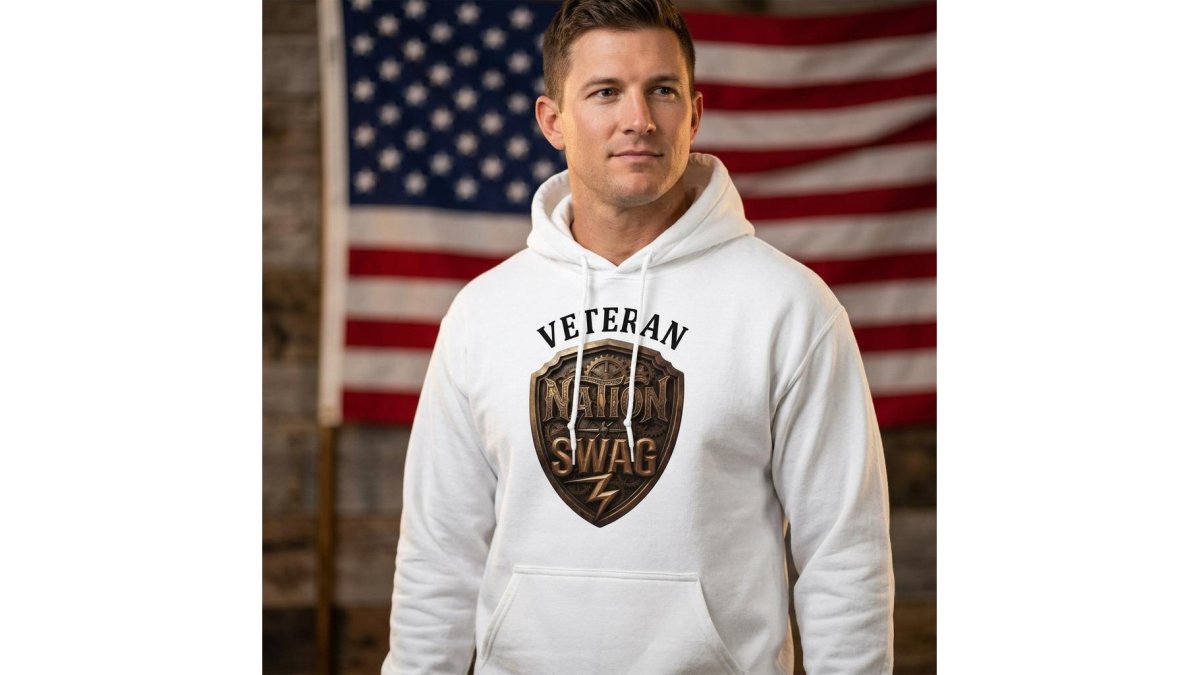
What the Sticker Price Actually Covers
A graphic tee's price tag bundles four things: the blank garment, the printing, the brand's overhead, and the retailer's cut. Mass-market brands spread those costs across millions of units; small veteran-owned operations spread the same fixed costs across a few hundred, so every shirt absorbs more of the setup, storage, and design work. That is the core of the price gap, and it has nothing to do with a logo being worth more.
Retail Markup vs. Direct Pricing
Retail markup is the layer most shoppers never see. When apparel moves through a distributor and then a store, each step adds its own margin. Direct-to-consumer veteran brands cut that chain, which is why a heavier hoodie can land at $43 to $45 instead of $70 or more at retail. You are paying for the garment, not for three middlemen.
Why Veteran Owned Apparel Costs More Than Mass-Market Graphic Tees
The short answer: heavier fabric and smaller runs cost more per unit. The longer answer comes down to three cost drivers that mass-market brands engineer out of their supply chains.
1. Blank cost per unit. A premium blank like the Gildan 18500 hoodie uses a 50/50 cotton-polyester blend with air jet yarn that resists pilling, a double-lined hood, and a heavier hand-feel than a thin, single-pass tee blank. Mass-market brands offset that cost with enormous volumes and rock-bottom per-unit pricing; a veteran-owned label ordering a few hundred pieces pays closer to full wholesale, and that difference flows straight to the price tag.
2. Setup cost spread across fewer units. Setting up a screen or a direct-to-garment printer costs roughly the same whether you run 50 shirts or 5,000. On a 5,000-unit run that setup is pennies per shirt; on a 50-unit run it can be several dollars per shirt before the blank is even touched. This is the single biggest reason a small-batch veteran brand cannot match a big-box price.
3. Supply chain transparency. A brand that can tell you exactly which mill spun its cotton, which facility cut and sewed the blank, and which print shop applied the graphic is paying for traceability at every step. That means fewer suppliers, longer lead times, and often domestic or near-domestic sourcing instead of the lowest global bid. Transparent sourcing adds a meaningful per-unit premium, but it lets the brand stand behind the garment's origin and labor conditions without hedging.
Small Batch Production and Its Real Costs
Small batch production means every design decision carries more weight. Veteran-owned brands accept this trade-off because it lets them release specific, meaningful designs without overproducing inventory that ends up in a landfill. A 200-unit run of a design that resonates sells through and funds the next release; a 200,000-unit run that misses sits in a warehouse, gets marked down, and is eventually liquidated or destroyed. Small batch is a risk-management choice that keeps the brand solvent and the designs intentional.
Premium Blanks and Fabric Weight
Fabric weight is measured in ounces per square yard, and it is the single biggest driver of how a shirt feels and how long it lasts. A heavier blank holds its shape through repeated washing, resists the thin, see-through look that plagues cheap tees, and takes a print more cleanly. That durability is baked into the price before a single graphic is printed: a Gildan 18500 hoodie is built to survive years of weekly wear, a generic mass-market fleece a season.
What Domestic Printing Actually Changes
Domestic printing changes who makes the shirt and how accountable they are for it.
Veteran Shield Strength Hoodie →
| Cost Factor | Mass-Market Graphic Tee | Veteran-Owned / Domestic Print |
|---|---|---|
| Production run | Millions of units | Hundreds of units |
| Fabric weight | Light, single-pass | Heavyweight, durable |
| Setup cost per unit | Pennies | Several dollars |
| Supply chain | Lowest global bid | Traceable, often domestic |
| Printing location | Often overseas | Domestic print shops |
| Retail layers | Distributor + retailer | Direct to consumer |
| Typical price point | Lowest | Mid-range ($19-$45) |
Patriotic Clothing Made in the USA: What Domestic Printing Changes
| Cost Factor | Mass-Market Graphic Tee | Veteran-Owned / Domestic Print |
|---|---|---|
| Production run | Millions of units | Hundreds of units |
| Fabric weight | Light, single-pass | Heavyweight, durable |
| Printing location | Often overseas | Domestic print shops |
| Retail layers | Distributor + retailer | Direct to consumer |
| Typical price point | Lowest | Mid-range ($19-$45) |
Cost-Per-Wear: The Metric That Changes the Math
Cost-per-wear is the price of a garment divided by the number of times you actually wear it, and it is the fairest way to compare a $19 shirt to a $45 hoodie.
How the Math Actually Works
A cheap tee that fades, cracks, or shrinks after a dozen washes might cost $19 but only survive 15 wears, more than a dollar per wear.
What Drives the Wear Count
Three construction details determine the wear count:
- Fabric weight. Heavier blanks resist thinning, stretching, and the see-through look that sends cheap tees to the rag bin early.
- Stitch construction. Double-needle stitching at the collar and hems, like the Gildan 5000 tee uses, prevents the seam failure that ends a cheap shirt's life first.
- Print method. A print that cracks or peels after a few washes makes the garment unwearable even if the fabric is fine. Domestic print shops using quality inks and proper curing extend the graphic's life to match the blank's.
Why This Metric Favors Veteran-Owned Brands
Supply Chain Transparency and Environmental Impact
Supply chain transparency means a brand can tell you exactly where its blanks come from, who printed them, and under what conditions.
Best Veteran Owned Apparel Brands and What to Look For
| Product | Price | Best For |
|---|---|---|
| Veteran Shield Strength Hoodie | $45.18 | Tactical lifestyle wear |
| United States Veteran Pullover Hoodie, Gildan 18500 | $43.18 | Everyday patriotic wear |
| Smoking Nation Swag Heavyweight Crewneck Tee, Gildan 5000 | $19.18 | Warm-weather casual wear |
| Nation Swag Classic Pullover Hoodie, Gildan 18500 | $43.18 | Versatile unisex fit |
How to Verify Veteran-Owned Claims Before You Buy
Frequently Asked Questions
Why is veteran owned clothing often more expensive than mall brands?
Veteran owned clothing usually costs more because it uses premium blanks, small batch production, and domestic printing. Big mall brands rely on mass-market overseas manufacturing and high-volume retail markup that hides lower fabric quality. When you buy veteran owned clothing, you pay for heavier fabric, better construction, and a brand mission that supports the military community, not just a logo.
Does veteran owned apparel offer better durability than big-box retailers?
In most cases, yes. Veteran owned brands often use heavyweight cotton or cotton-poly blends like Gildan 18500, which hold up to repeated washing. Big-box retailers frequently use thinner fabric and lower-quality screen printing that cracks or fades within months. Checking fabric weight and garment construction before buying tells you more about durability than the brand name alone.
How do I verify if a clothing brand is truly veteran-owned?
Look for transparency on the brand's website. Legitimate veteran owned clothing brands list their founder's service history or link to third-party certifications. If a brand makes vague patriotic claims without proof, treat it as marketing until you see documentation.
What are the benefits of supporting small veteran owned businesses over corporate giants?
Supporting small veteran owned businesses keeps money in local communities and often means better quality control because the owner is directly accountable. You also get supply chain transparency that mass-market brands rarely provide. For patriotic clothing made in the USA, buying from a veteran owned brand ensures your purchase aligns with the values the design represents, not just a corporate profit margin.
Are there hidden costs in mass-produced patriotic clothing?
Yes. Mass-produced patriotic apparel often hides costs in lower fabric weight, cheaper screen printing that fades, and overseas labor practices that don't match the values the design implies. A $15 graphic tee that loses its shape after five washes costs more per wear than a $45 hoodie that lasts years. Cost-per-wear analysis exposes these hidden costs quickly.